European Business in Georgia
Growth, Challenges and Future Prospects
By David Ashotian, Researcher at the EBA Economic Policy Committee
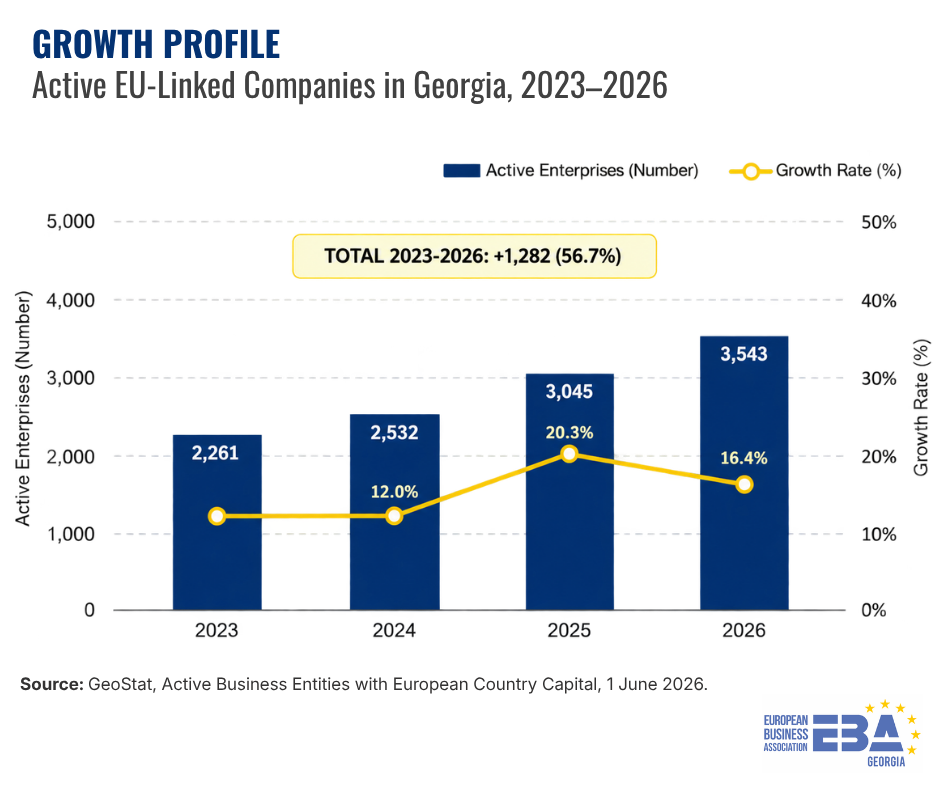
European business activity in Georgia has expanded markedly in recent years. The number of active enterprises linked to EU capital increased from 2,261 in 2023 to 3,543 in 2026, representing cumulative growth of 56.7%.
That growth is significant, but the number of companies alone does not explain the full picture. A clearer understanding requires looking at the structure of this business base: where these firms come from, which sectors they operate in, how they are owned and sized, where they are located, and how businesses themselves assess the environment in which they operate.
Two studies developed through the European Business Association Georgia Economic Policy Committee – “European Business in Georgia 2026” and “EBA Members Business Outlook 2026” – approach these questions from complementary perspectives. The first maps the quantitative structure of European business activity in Georgia, while the second adds the experience and expectations of companies operating within that environment.
GROWTH IS ONLY THE STARTING POINT
The expanding European business base is broad, but not evenly distributed. Germany represents the largest individual country presence, accounting for 25.2% of EU-linked enterprises, while the five largest source countries together account for 53.4%. This indicates both concentration among major markets and participation from a wider range of EU economies.
A similar pattern appears across sectors. ICT is the largest identified area of activity, followed by professional services and wholesale and retail. The five largest identified sectors account for 69.1% of enterprises for which industry information is available. Because sector data covers 2,156 of the 3,543 EU-linked enterprises, the distribution should be read within that coverage.
The structure becomes even clearer when size, ownership and location are considered. Among enterprises with available size data, 93% are classified as small, while 84% of EU-linked enterprises are fully EU-owned. Geographically, 79.4% are concentrated in Tbilisi. Taken together, these findings describe a European commercial presence that extends well beyond large multinational corporations and is largely composed of smaller, directly European-owned firms with a strong presence in technology, services and commerce.
Foreign direct investment adds a complementary perspective. EU FDI reached approximately USD 525 million in 2025, up 18.7% from the previous year and accounting for around 31% of Georgia’s total FDI. Together, these findings highlight both the growing scale of European business and investment activity in Georgia and an important opportunity for further development: attracting more medium-sized and large European enterprises to strengthen the country’s investment base and support long-term economic growth.
WHAT BUSINESSES THEMSELVES ARE EXPERIENCING
The structural data explains what the European business presence looks like. The next question is how companies operating in Georgia view their own prospects. The EBA Members Business Outlook 2026 provides that qualitative dimension. EBA’s business community includes more than 100 companies across more than 15 sectors, collectively representing more than 34,000 jobs and GEL 5.8 billion in annual turnover.
Among surveyed members, 89% reported stable or improved business conditions, while 59% expected their businesses to expand during the following year. At the same time, companies highlighted several factors that influence their ability to grow, including access to qualified talent, skills gaps, suitable financing for new projects, technology, regulatory clarity and the conditions required for longer-term planning.
This is where the two studies meet. The first shows that the European business presence has expanded substantially and clarifies what that presence looks like; the second helps explain the conditions that may shape what happens next.
A growing number of enterprises is an important indicator of commercial activity, but long-term economic value depends on more than market entry. It also depends on whether companies are able to remain active, expand operations, invest, develop their workforce and deepen their commercial activity over time. The business discussion accompanying the research reflected the same distinction, with recurring themes including business sustainability, access to finance, talent, technology, regulatory clarity and the conditions for long-term growth.
RESEARCH, DIALOGUE AND THE ROLE OF YOUNG PROFESSIONALS
The EBA Economic Policy Committee provides a platform for connecting economic analysis with the practical experience of businesses and for supporting evidence-based dialogue. Young professionals also contributed through EBA’s “Youth in Economic Policy-Making” initiative, supporting data collection, analysis and research preparation. Their involvement helped connect academic knowledge with real economic and business questions while bringing new perspectives into the research process.
The latest findings point to a substantial and expanding European business presence in Georgia. Over time, however, the strength of that presence will increasingly be reflected not only in how many companies enter the market, but also in their ability to stay, scale, invest and create durable economic value.